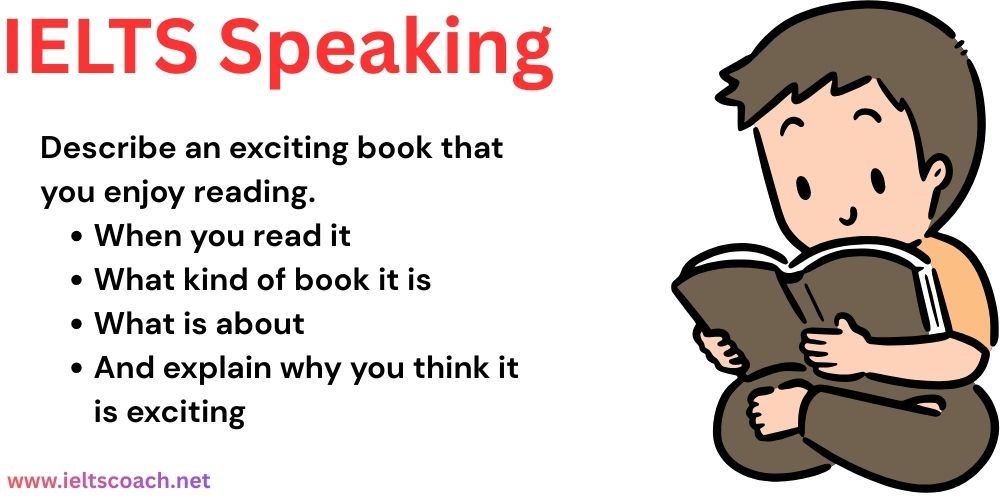

- Describe an exciting book that you enjoy reading.
- When you read it
- What kind of book it is
- What is about
- And explain why you think it is exciting
Sample Answer 1
I would like to talk about a novel I read a couple of years ago that completely captivated and mesmerized me: The Silent Patient by Alex Michaelides.
I read this book during a long weekend while visiting my family. Since I had plenty of free time and the storyline was utterly compelling, I ended up devouring the entire novel in just two days. Once I began reading, I simply could not tear myself away from it.
This book belongs to the genre of a psychological thriller, a category of fiction that delves deeply into the intricate psyche of its characters rather than relying solely on external crime-solving. Instead of being a conventional detective story, the novel places strong emphasis on human psychology, emotional complexity, and concealed motivations, which made the reading experience profoundly immersive for me.
The plot centers on Alicia Berenson, a famous painter who is accused of murdering her husband, Gabriel. After the incident, she becomes catatonically silent, refusing to speak even a single word. She is confined to a secure forensic psychiatric institution called The Grove. The protagonist, Theo Faber, a psychotherapist, takes up a position there because he is obsessively determined to unlock Alicia’s silence and unravel the truth behind the crime. What follows is a psychological duel between patient and therapist, as Theo meticulously investigates her past and the mysterious circumstances surrounding the murder.
What made this book exceptionally exciting was, first of all, its relentless pacing. Every chapter ends on a dramatic cliffhanger or introduces a subtle revelation, creating a continuous sense of anticipation and suspense. Secondly, the true thrill lies in the novel’s mind-bending plot twist. Throughout the story, readers construct their own theories, but the final revelation is completely unforeseen and utterly blindsiding. The author masterfully subverts expectations, forcing you to re-evaluate the entire narrative from a new perspective. That unforgettable twist left me genuinely astounded, which is why I still regard this book as one of the most exhilarating novels I have ever read.
Vocabs
| Word/Phrase | Meaning | Example Sentences |
|---|---|---|
| Captivated / Mesmerized | Deeply interested or fascinated. |
|
| Compelling | Extremely engaging or convincing. |
|
| Intricate psyche | Complex human mind. |
|
| Concealed motivations | Hidden reasons behind behavior. |
|
| Immersive | Emotionally absorbing. |
|
| Catatonically silent | Unnaturally or completely silent. |
|
| Obsessively determined | Intensely focused on a goal. |
|
| Psychological duel | A mental power struggle. |
|
| Relentless pacing | Story that moves fast without slowing. |
|
| Anticipation / Suspense | Anxious curiosity about what will happen next. |
|
| Mind-bending plot twist | Shocking narrative reversal. |
|
| Utterly blindsiding | Totally unexpected. |
|
| Subverts expectations | Deliberately surprises the audience. |
|
| Astounded / Exhilarating | Amazed / thrilling. |
|
Follow-up Questions
1. Do you think reading habits are changing these days?
Yes, I believe reading habits have shifted significantly due to technology. Many people now prefer short-form digital content such as social media posts, blogs, or online articles rather than lengthy novels. While this makes reading more accessible and convenient, it has arguably reduced our attention spans and deep reading ability, which requires sustained concentration. Unfortunately, literary reading for pleasure has become less popular, especially among younger audiences.
2. What types of books are most popular in your country?
In my country, people are particularly drawn to self-help books, motivational literature, and competitive exam preparation guides. Psychological thrillers and romance novels also attract a strong readership because of their entertaining and escapist nature. Meanwhile, non-fiction books related to personal development and financial literacy have seen a noticeable surge in popularity, as many readers are now focused on practical self-improvement.
3. Why do some people prefer watching movies instead of reading books?
Many people favor movies because they offer instant gratification—they can complete a story in two hours without the mental effort that reading requires. Films also provide visual stimulation and emotional intensity through cinematic effects and soundtracks. However, books demand active imagination, which can feel mentally taxing for some. As a result, people who seek quick entertainment often choose movies over literature.
4. Do you believe reading fiction is simply entertainment, or does it have educational value too?
I firmly believe fiction serves both purposes. Beyond entertainment, it offers profound educational and psychological benefits. Fiction enhances empathy by encouraging readers to understand diverse perspectives and emotional experiences. It also strengthens analytical thinking, vocabulary, and narrative comprehension. Most importantly, novels frequently explore complex moral dilemmas, which subtly shape readers’ emotional intelligence and social awareness.
5. Should children be encouraged to read more books instead of using mobile phones?
Absolutely. Excessive mobile phone use promotes passive consumption of content, whereas reading stimulates active cognitive engagement. Books improve language skills, imagination, and sustained focus—abilities that screen usage rarely cultivates. While technology should not be banned altogether, parents should establish balanced habits by encouraging daily reading routines alongside controlled screen time.
6. Do you think paper books will disappear in the future due to e-books?
I highly doubt they will disappear entirely. Despite the rise of digital reading, physical books offer a tactile and immersive experience that technology simply cannot replicate. Many readers appreciate the sensory aspects—the feel of pages, the smell of books, and the absence of screen fatigue. Therefore, although e-books will continue expanding, printed books will remain culturally relevant.
7. Are book adaptations into movies generally successful?
It depends. While movie adaptations can visually enhance storytelling, they often struggle to faithfully capture a book’s psychological depth and narrative complexity. Important details and internal monologues are frequently removed for time constraints. Consequently, viewers who have read the original novel sometimes feel disappointed. However, when adaptations remain loyal to the source material, they can be extremely successful and impactful.